Introduction
Highland barley, also named hulless barley, is widely planted in plateau areas all over the world, such as Tibet Autonomous Region, Qinghai Province, Sichuan Province and Yunnan Province in China, northwest Indian Himalayas, Nepal, Ethiopia, highland areas of German and Canada, and Central Siberian Highlands in Russia, which covers a vast area about of 2.61 × 10⁶ square kilometers (Zhang et al., 2019). Highland barley is famous for its rich nutritional and bioactive compounds (Guo, Horvath, Chen, Chen, & Zheng, 2020). Detailly, starch is the main component of highland barley and it accounts for about 49.14 % − 68.62 %, the predicted glycemic index of it is about 39.4–47.5 (less than 55), so highland barley is usually recognized as a low GI cereal that suitable for diabetic patients (Moza., 2016). The dietary fiber content of highland barley accounts for about 8.16–21.46 %, which was higher than that of wheat (10.2 % − 15.7 %), rice (2.7 % − 7.9 %), maize (13.1 % − 19.6 %), sorghum (7.55 % − 12.3 %) and millet (13.0 % − 13.8 %) (Obadi et al., 2021). In addition, highland barley not only shows high content of protein, mineral and vitamin, but also it is rich in various bioactive components such as β-glucan (3.66–8.62 %, w/w), phenolics (131–178 mg/L) and flavonoids (145.5–247.4 mg /100 g). Detailly, many studies have proven that β-glucan could relieve the cardiovascular diseases by inhibiting cholesterol synthesis and reduces low density blood fat content, and it also associated closely with diabetes by regulating the blood glucose level. These functional chemicals in barley can play an important protective role against metabolic diseases, certain types of cancer and cardiovascular diseases due to their antioxidant potential, probiotic properties (Zhang et al., 2017). So, it is currently gaining attention as a health food in China, Europe, North America and other non-traditional barley growing areas (Ehrenbergerova, Belcrediova, Pryma, Vaculova, & Newman, 2006). However, most of the researches on highland barley is focused on the analysis of nutritional composition and extraction of functional components recently, the research on the deep processing and comprehensive utilization of highland barley as raw material is not deep enough. Vinegar production is one of the ways in which the value of materials can be added, since highland barley is the main source of carbohydrates used in fermentable sugars.
Vinegar, as a vital seasoning for various food preparation, has been known for more than ten thousand years history in the world (Giudici et al., 2017). Due to its beneficial health effects, it was also once used in ancient times as a tonic, a food preservative, a condiment, and to treat diseases such as sores, stomachache, high fever, and edema in Japan, United States and Europe. In China, more than 3.2 million litres vinegar is consumed every day as a traditional condiment made from cereal and are usually used in cooking and the production of food, which directly affect the health of consumers (Ho, Lazim, Fazry, Zaki, & Lim, 2016). The most classical vinegar in China is brewed from starchy grains such as sorghum, rice or glutinous rice using the solid-state fermentation process, and is represented by Shanxi aged vinegar and Zhenjiang vinegar (Zhang et al., 2022). In the production of the traditional solid-state fermentation-type vinegar, the raw materials (starchy cereal and the starter Daqu) are well mixed mechanically for starch saccharification and alcohol fermentation, then added the supplementary and filling materials includes wheat bran and rice chaff to acetic acid fermentation. The whole brewing process of vinegar is the metabolic activity of variety of microorganisms that mainly include fungi (like mold, yeast) and bacteria (like acetic acid bacteria) on the starch, fermentable sugars, and proteins of the materials. (Zhang et al., 2022, Kou et al., 2022; Wu et al., 2021). For instance, the molds usually play a vital role in saccharification stage and the yeasts are critical in alcoholic fermentation stage (Li, Li, Liu, Luo, & Lin, 2016). And yet, dynamic changes in the environment and raw materials may lead to differences in microbial succession, which further introduce uncertainty in safety assurance and flavor formation of vinegar.
To date, many researches have reported that the microbial succession fermentation contributes significantly to the flavor enhancement, which mainly because the microbiota could convert different substrates to various flavor compounds. The characteristics of Shanxi aging vinegar, Fuyu-flavor Baijiu, and Chinese te-flavor baijiu Daqu were reported to be affected by microorganism variation (Kou et al., 2022; Kang et al., 2022; Fu et al., 2021). It is also important to explore the dynamic changes of microorganisms in the brewing process of highland barley vinegar. Moreover, flavor as one of the most main attributes of vinegar, there have been many studies focused on it. The main flavor compounds of Longmen vinegar were phenyl acetone, ethyl benzoate, creosol, ethyl 2-hydroxy 4-methylpentanoate and ethyl succinate (Al-Dalali, Zheng, Li, Huang, & Chen, 2019). Furfural, acetoin and tetramethylpyrazine were considered as the aroma biomarkers of Zhejiang rosy vinegar (Zhang, Qin, Zhang, Jiang, & Zhu, 2022).
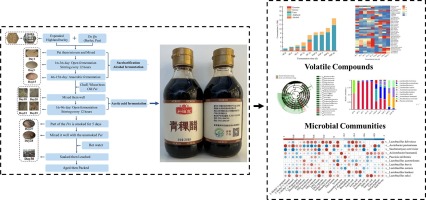
Therefore, solid-state fermented highland barley vinegar could be developed into a new type of vinegar to meet the diversified needs of consumer and to improve the deep processing and comprehensive utilization of highland barley. The present study performed Illumina HiSeq sequencing to investigate the dynamics in bacterial and fungal community succession at different fermented stages. The flavor compounds were analyzed by Headspace solid-phase microextraction (HS-SPME) in combination with gas chromatography-mass spectrometry (GC–MS) with quantitative methods. The functional components content of polyphenols and flavonoids and the antioxidant activity were also assessed in the present study. The results and conclusion of this study will provide an overall perspective understanding this new type vinegar.